
How Multi-Currency works
The WPResidence Multi-Currency feature converts the original property price into a new value based on the currency selected by the visitor from the Multi-Currency Widget.
WPResidence has one main currency and one price per property. There is no option to save different prices for the same property, such as one price in EUR and another price in USD.Each property price is saved and originally displayed using the main currency set in Theme Options > General > Price & Currency.
Video guide
Where to manage Price & Currency options
To manage the price and multi-currency options, go to:
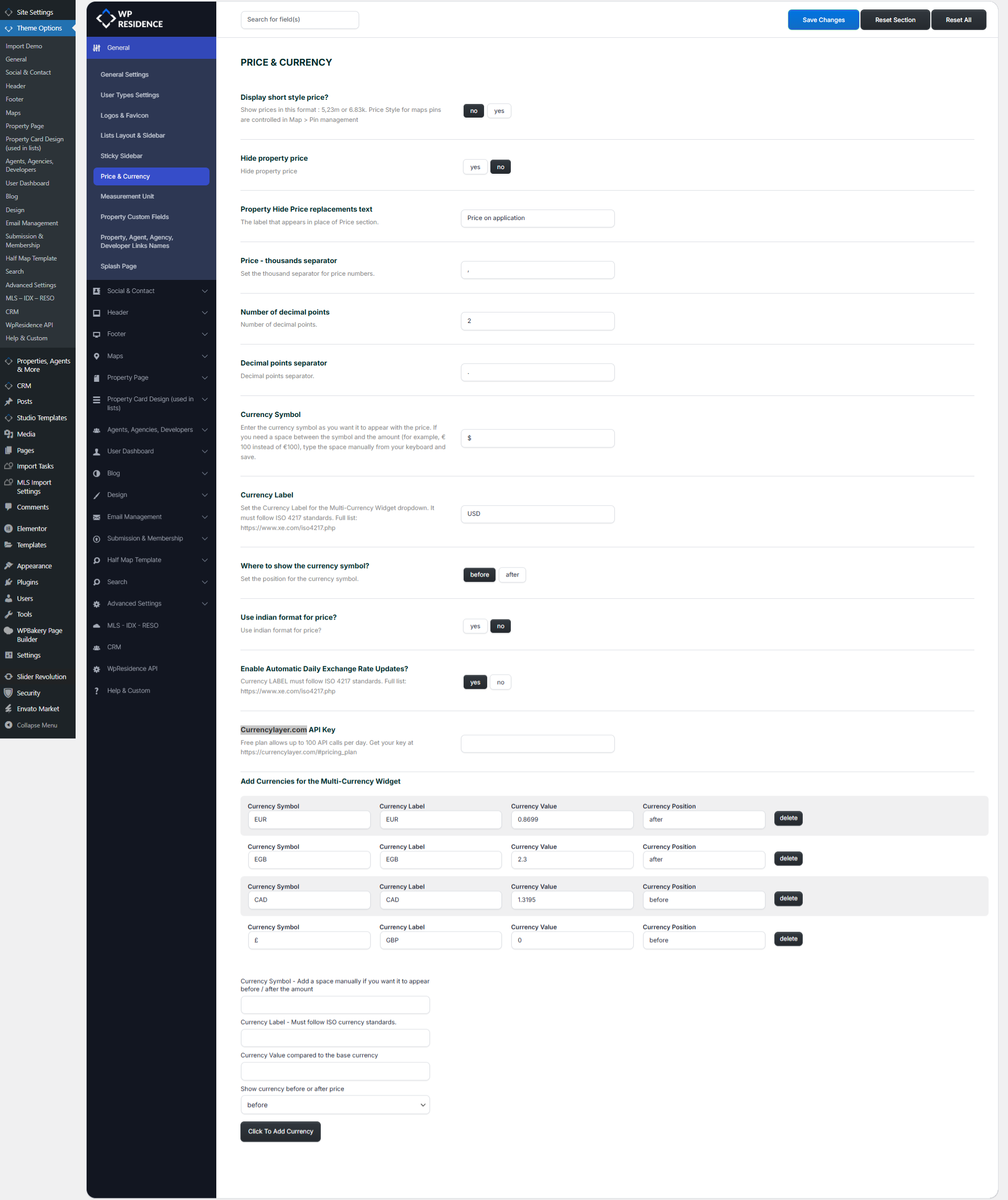
Theme Options > General > Price & Currency
From this section, you can manage the main price display, number format, currency symbol, currency label, automatic exchange rate settings, and the additional currencies used by the Multi-Currency Widget.
Display short style price
The option Display short style price? controls if large prices are shown in a shorter format.
For example:
- 5,230,000 can show as 5.23m
- 6,830 can show as 6.83k
This option affects the way prices are displayed in theme areas that support short price formatting.
Price style for map pins is controlled separately from Maps > Pin Management.
Hide property price
The option Hide property price allows you to hide the numeric property price and show a replacement label instead.
Use Property Hide Price replacements text to add the label that should appear in place of the price.
Example:
Price on application
This is useful when you do not want to show the property price publicly.
Price number format
The price number format controls how property prices are displayed.
Available options include:
- Price thousands separator: sets the separator used for thousands, for example comma or dot.
- Number of decimal points: controls how many decimals show after the price.
- Decimal points separator: sets the separator used for decimal values.
Example:
- Thousands separator: ,
- Decimal points: 2
- Decimal separator: .
This allows you to match the price format used in your country or business setup.
Main currency symbol and label
The Currency Symbol is the symbol used for the main property price.
Examples:
- $
- €
- £
If you need a space between the currency symbol and the amount, add the space manually in the currency symbol field.
The Currency Label is used for the Multi-Currency Widget dropdown and should follow ISO 4217 currency standards.
Examples:
- USD
- EUR
- GBP
The option Where to show the currency symbol? controls if the currency symbol appears before or after the price.
- Before: $500,000
- After: 500,000 €
Indian price format
The option Use Indian format for price? changes the price display to the Indian numbering format.
This is useful for websites where prices should be displayed in Indian number grouping.
Example:
12,500,000 can show as 1,25,00,000
Automatic exchange rate updates
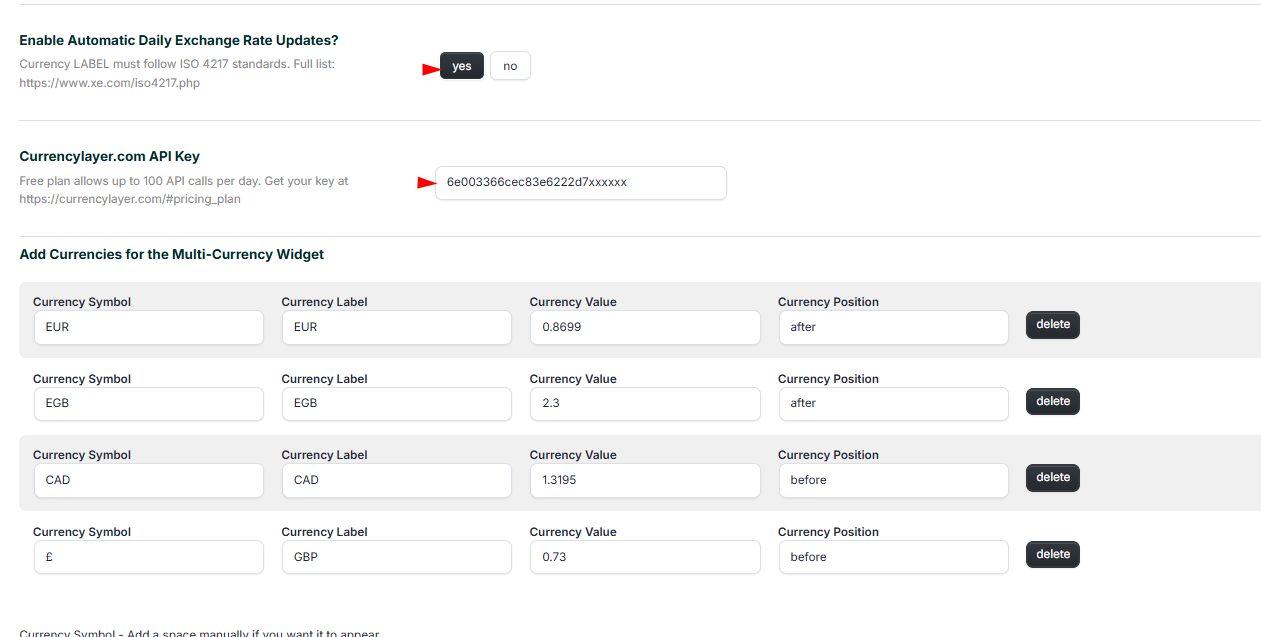
WPResidence can update currency values automatically with an exchange rate API.
To use automatic daily exchange rate updates, configure these options:
- Enable Automatic Daily Exchange Rate Updates.
- Add your Currencylayer.com API Key.
- Use correct international currency labels, such as USD, EUR, GBP.
You can get the API key from:
https://currencylayer.com/dashboard
Currency labels must follow ISO 4217 standards:
https://www.xe.com/iso4217.php
Currency values can change from day to day. When automatic exchange rate updates are enabled, the theme uses a daily cron job to update the currency values in Theme Options.
Add currencies for the Multi-Currency Widget
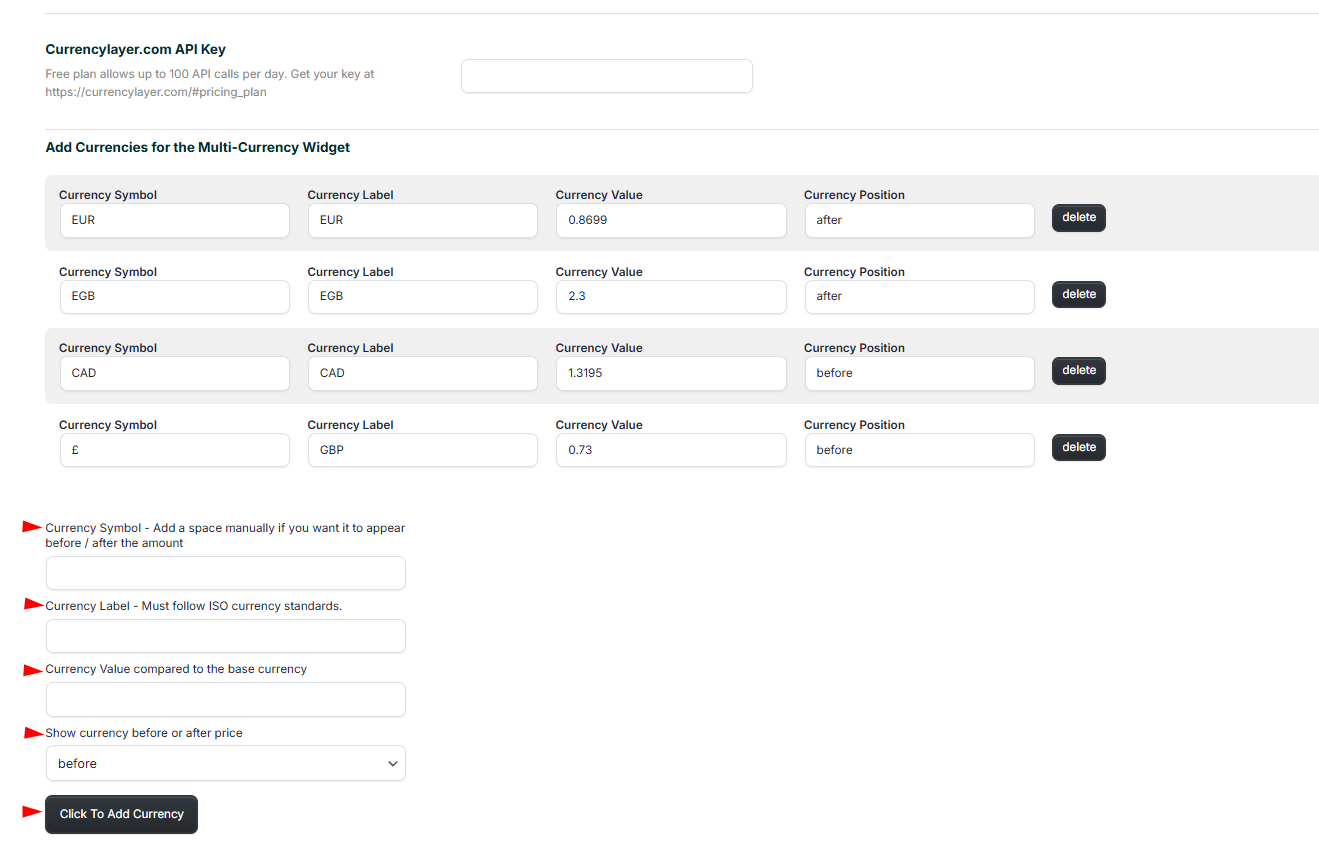
Use Add Currencies for the Multi-Currency Widget to create the currencies visitors can select from the widget dropdown.
For each currency, you can set:
- Currency Symbol: the symbol displayed with the price, such as €, £, or $.
- Currency Label: the ISO currency label, such as EUR, GBP, or USD.
- Currency Value: the value compared to the base currency.
- Currency Position: choose if the currency symbol shows before or after the price.
To add a new currency:
- Add the currency symbol.
- Add the currency label.
- Add the currency value compared to the base currency.
- Select if the currency symbol should show before or after the price.
- Click Click To Add Currency.
- Save changes.
Example:
If your main currency is EUR and 1 EUR = 0.86 GBP, then the GBP currency value can be set to 0.86.
The Multi-Currency Widget converts the original property price using the values saved in this section. It does not create separate saved prices for each property.
Where the Multi-Currency Widget can be used
The Multi-Currency selector can be added in two main ways:
- As a standard WordPress widget, added from Appearance > Widgets to a sidebar or widget area.
- As a WPResidence Elementor/Studio widget, added inside custom Elementor templates such as headers or footers.
This means you can show the currency switcher in traditional widget areas, or inside a custom header/footer built with WPResidence Studio.
Add the Multi-Currency Widget to WordPress widget areas
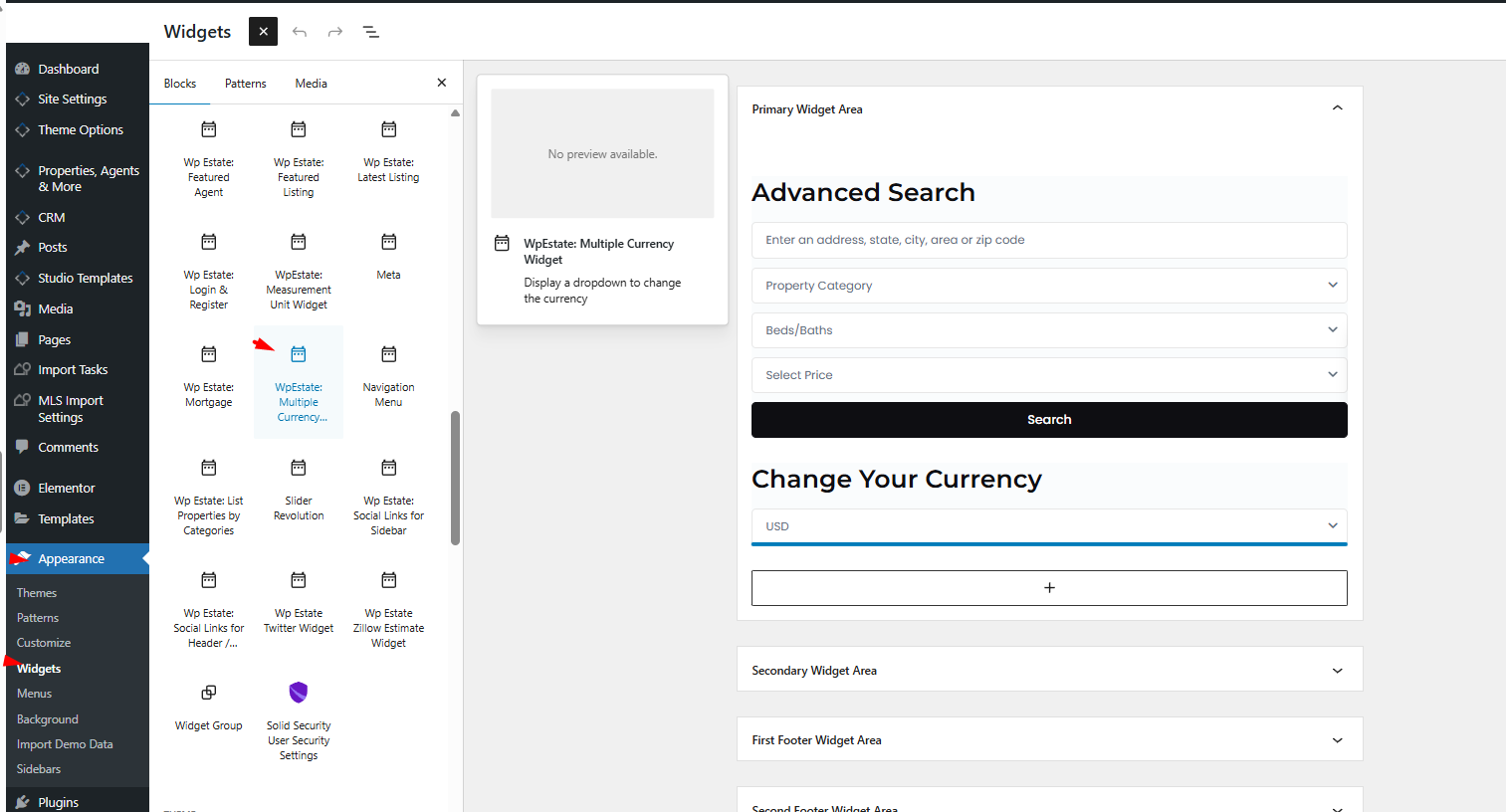
To add the Multi-Currency Widget to a standard WordPress widget area, go to:
Appearance > Widgets
Then add the Multi-Currency Widget to the widget area where you want it to show.
For example, you can add it to:
- Header widget areas
- Footer widget areas
- Sidebar widget areas
- Other theme widget areas available in Appearance > Widgets
When a visitor changes the currency from the dropdown widget, the theme reads the currency value saved in Theme Options and converts the original property price.
Add the Multi-Currency Widget in WPResidence Studio templates
The Multi-Currency Widget can also be used inside WPResidence Studio templates with Elementor.
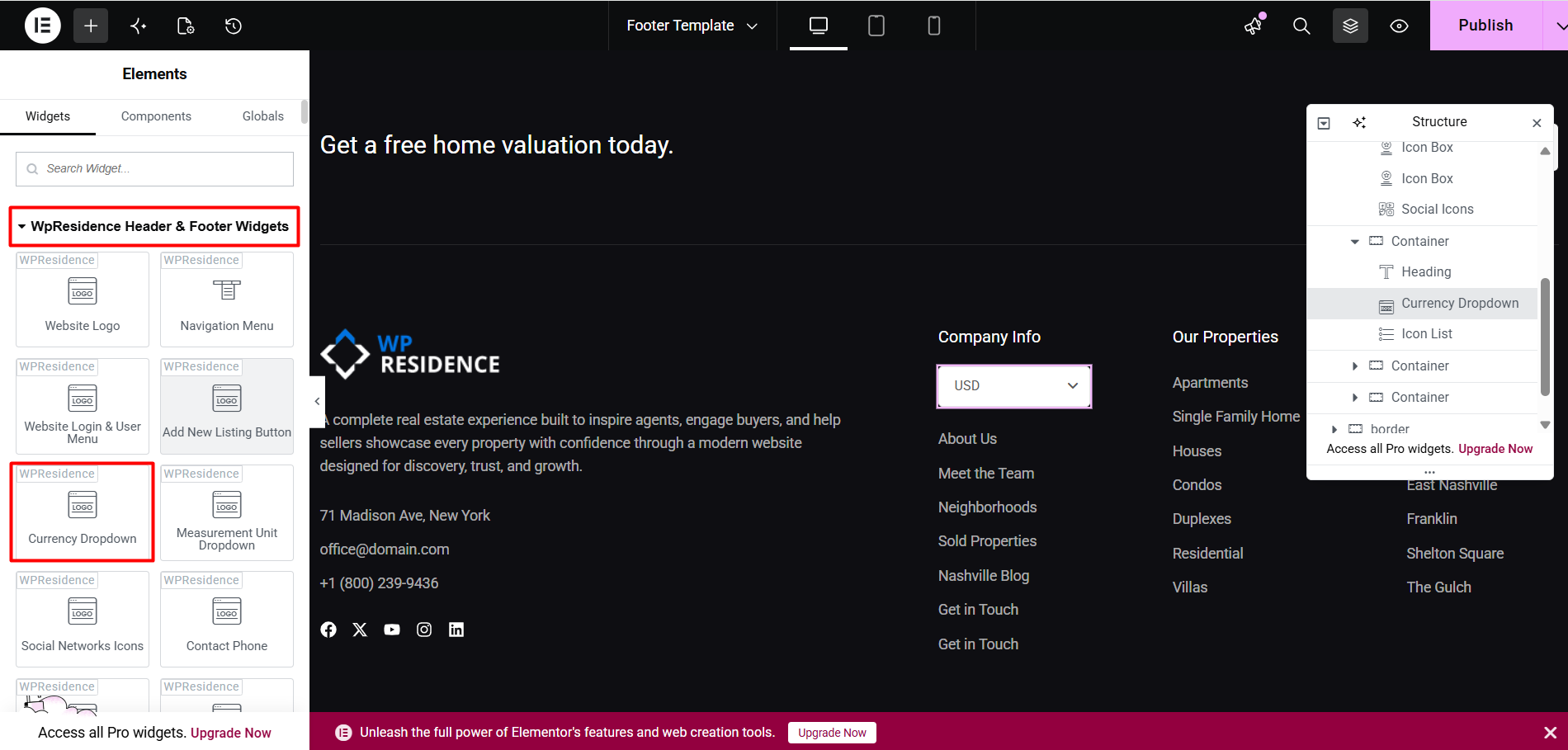
This is useful when you create a custom header or footer and want to place the currency selector directly inside that design.
For example, you can add the Multi-Currency Widget inside:
- Custom Header templates
- Custom Footer templates
- Before Header templates
- After Header templates
- Before Footer templates
- After Footer templates
To use it this way:
- Create or edit your WPResidence Studio header or footer template.
- Click Edit with Elementor.
- Search for the WPResidence Multi-Currency widget in Elementor.
- Drag the widget into the header, footer, or template section where you want it to appear.
- Save the template and check the frontend.
If you use a custom WPResidence Studio header or footer, the standard header/footer widget areas from Appearance > Widgets may not show in that location, because the Studio template replaces the default theme header or footer where it is assigned.
Related help:
How to create custom header and footer with WPResidence Studio
Cookies and caching
The selected currency is saved as a cookie on the visitor’s computer.Some cache plugins may interfere with this behavior. If the selected currency does not stay active, or if the wrong currency is shown, check your cache plugin settings.
If you use a cache plugin, read this guide:
How to use a cache plugin with the Multi-Currency Widget dropdown
Multi-Currency does not sync with the Auto Exchange API
If the Multi-Currency values do not sync while the Auto Exchange API is enabled, contact your hosting provider and ask them to allow the server function required for remote API calls.
After the hosting provider confirms the function is active, save the currency settings again.
After saving the currency settings, clear cache and test the Multi-Currency Widget again on the frontend.